




Spotlights
Water Resources Planner, Water Quality Technician, Water Quality Analyst, Water Quality Engineer, Water Quality Scientist, Water Quality Consultant, Water Quality Inspector, Environmental Analyst (with a focus on water quality)
The human body is made of 50-60% water. That’s why we need to drink ~12-15 cups of the stuff every day, on average. But due to natural and manmade circumstances, water has a tendency to become polluted.
In fact, drinking water is commonly tainted with hundreds of contaminants ranging from nitrates and herbicides to mercury and lead. There are even chemicals that are intentionally added such as chlorine and fluoride, which we’re told are safe up to certain levels. But how do we know when our water is up to standards?
Water Quality Specialists study and inspect various bodies of water and water sites, such as rivers and lakes as well as groundwater and wastewater treatment centers. They test and analyze the chemical, physical, and biological properties of water and compare findings against regulatory standards to determine if it’s safe for whatever it’s being used for.
Overall, their job is to protect the environment and the life forms—including us—who rely on safe, clean, unpolluted water to survive!
- Protecting ecosystems that rely on clean water
- Ensuring human populations have enough safe, clear water
- Impacting the physical health and well-being of communities
Working Schedule
Water Quality Specialists work full-time jobs with nights, weekends, and holidays off. However, overtime or odd hours may be needed during emergencies. Travel for fieldwork and site visits is often needed and exposure to inclement weather or conditions may be necessary.
Typical Duties
- Conduct fieldwork and site visits to take soil/water extract samples, monitor situations, look for hazards, and conduct inspections to ensure compliance
- Analyze wetland, floodplain, and shoreland maps; use GPS, maps, and photos to determine locations during fieldwork
- Collect data from water site sensors; compile data using software and analyze results
- Prep samples for cation and anion testing, as needed
- Understand water and pollutant properties and effects on ecosystems
- Look for signs of pollutants and environmental changes that impact bodies of water (such as how floods affect lakes, fish, and wildlife)
- Manage Illicit Discharge Detection and Elimination programs
- Collaborate with appropriate governmental agencies when discovering and reporting pollution activities
- Assess construction projects for environmental impacts on water and wildlife habitats
- Monitor, inspect, and help with water delivery controls, water system connections, meters, potable water distribution systems, production wells, mains, lines, etc.
- Maintain pond filtration systems
Additional Responsibilities
- Stay up-to-date on water-related regulations, standards, and challenges
- Submit logs, records, and technical reports to local, state, or federal agencies
- Oversee contractors working on water-related projects
- Help with public education and awareness programs
- Calibrate equipment, track samples, enter data, and coordinate with labs
- Keep track of invoices
- Respond to public queries and complaints. Investigate complaints, as directed
A Water Quality Specialist spends much of their day monitoring, testing, and evaluating water to make sure it is safe for people, wildlife, and the environment. One morning, they might collect water samples from rivers, lakes, groundwater wells, industrial facilities, or drinking water systems. Later, they could analyze samples in a laboratory to measure pH levels, dissolved oxygen, bacteria, chemicals, nutrients, and other contaminants. They may also inspect water treatment facilities, investigate pollution sources, review testing results, and prepare reports explaining whether water meets environmental and public health standards. Some specialists work with engineers, environmental scientists, government agencies, and community organizations to develop solutions for water pollution and improve water management practices. Their work helps protect drinking water supplies, aquatic ecosystems, and public health.
Soft Skills
- Activities Coordination
- Analytical
- Attention to detail
- Critical thinking
- Decisive
- Detail-oriented
- Independent
- Interpersonal skills
- Monitoring
- Objective
- Organized
- Perceptive
- Problem-solving
- Safety-oriented
- Stamina
- Strong communication skills
Technical Skills
- Data entry, analysis, and interpretation skills
- Environmental monitoring
- Familiarity with local, state, and federal water quality regulations
- Geographic Information System (GIS) programs
- Hydrology principles and concepts
- Knowledge of water quality monitoring instruments (pH meters, dissolved oxygen meters, turbidity sensors, spectrophotometers, etc.)
- Knowledge of water sampling and analysis equipment/software
- Microbiology
- Personal protective equipment use
- Project management
- Quality Assurance/Quality Control
- Safety protocols working around pollutants, bacteria, and chemicals
- Water quality modeling
- Water treatment technologies
- Drinking Water Quality Specialist: Monitors public and private drinking water supplies to ensure water meets safety standards and is free from harmful contaminants.
- Surface Water Quality Specialist: Studies rivers, lakes, streams, and reservoirs to assess pollution levels, water conditions, and the health of aquatic ecosystems.
- Groundwater Quality Specialist: Tests underground water sources for chemicals, bacteria, minerals, and other contaminants that could affect drinking water supplies.
- Wastewater Quality Specialist: Monitors wastewater treatment processes and tests treated water to ensure pollutants are properly removed before discharge.
- Industrial Water Quality Specialist: Evaluates water used in manufacturing plants, factories, and industrial facilities to ensure it meets operational and environmental requirements.
- Environmental Water Quality Specialist: Investigates water pollution, monitors environmental conditions, and helps develop strategies to protect natural water resources.
Aquatic Ecosystem Water Quality Specialist:** Studies how water conditions affect fish, plants, microorganisms, and other aquatic organisms in freshwater and marine environments. - Water Quality Laboratory Specialist: Conducts laboratory tests on water samples to identify contaminants, measure chemical and biological properties, and prepare analytical reports.
- Local, state, and federal governmental agencies
- Educational institutions
- Private consulting service providers
Water Quality Specialists get out in the field to conduct assessments and gather samples, so expect regular travel and exposure to the elements. Communities rely heavily on the accuracy and diligence of these workers to ensure water is safe for consumption by residents or for various other purposes. Of course, fish and wildlife creatures depend on clean water to survive, too!
Facing major challenges such as corporate pollution and climate change, Water Quality Specialists must stay devoted to identifying and overcoming problems before they become too serious to handle. It’s a lot of responsibility to manage at times!
In addition, workers in this field may be exposed to various contaminants, including pollutants, bacteria, and chemicals. While personal protective equipment mitigates most exposure, the hazards are still present so specialists have to work carefully and follow strict procedures.
Water Quality Specialists have their hands full because of the issues impacting water quality. For instance, numerous emerging contaminants such as chemicals and other substances are being detected in water, but there aren’t sufficient studies to regulate them or determine if they’re harmful to human health or the environment.
Scientists are working to advance wastewater treatment technologies to boost available water supplies, while the Internet of Things is helping with the development of smart water quality monitoring systems. Excess nitrogen and phosphorus from agricultural runoff and wastewater discharge are contributing to oxygen depletion in water bodies, harming fragile aquatic ecosystems. Meanwhile, climate issues such as rising temperatures, changing precipitation patterns, and extreme weather events are driving concerns because of their effects on water bodies.
Water Quality Specialists probably enjoyed being outdoors, going fishing, or swimming in natural bodies of water. They care about the environment and public health and could have seen their own communities affected by pollution. They’re also analytical and may have been good in STEM subjects from an early age!
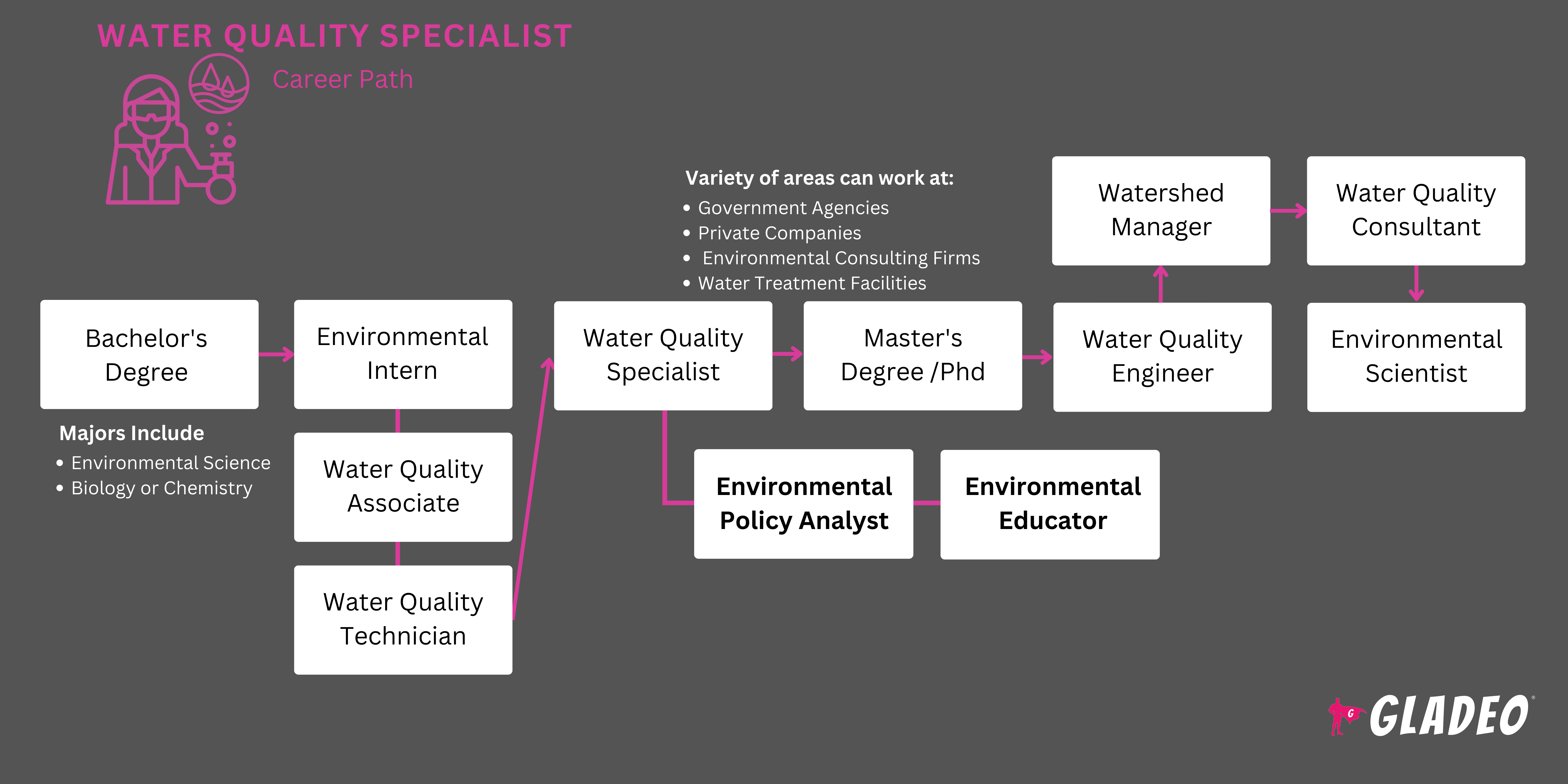
Becoming a Water Quality Specialist typically requires a bachelor's degree in Environmental Science, Chemistry, Biology, Water Resources Management, Environmental Engineering, or a related field. These programs provide a foundation in water chemistry, environmental monitoring, microbiology, pollution control, and laboratory analysis. Some entry-level positions may accept an associate degree combined with relevant laboratory or field experience, while advanced research and specialized positions may require a master's degree or Ph.D.
Relevant coursework may include:
- Water Chemistry: Studying the chemical properties of water, including pH, dissolved oxygen, alkalinity, hardness, nutrients, and chemical contaminants.
- Environmental Science: Learning about environmental systems, pollution, natural resource management, and the effects of human activities on water and ecosystems.
- Microbiology: Studying bacteria, viruses, algae, and other microorganisms that can affect water safety and quality.
- Hydrology: Understanding how water moves through the environment, including rainfall, groundwater, surface water, and drainage systems.
- Water and Wastewater Treatment: Learning the processes used to remove physical, chemical, and biological contaminants from drinking water and wastewater.
- Analytical Chemistry: Developing laboratory skills to identify, measure, and analyze chemical substances in water samples.
- Aquatic Ecology: Studying freshwater and marine ecosystems and understanding how water quality affects aquatic plants, animals, and microorganisms.
- Environmental Toxicology: Learning how pollutants, chemicals, and toxic substances affect human health and aquatic organisms.
- Environmental Microbiology: Studying microorganisms in natural and treated water systems, including methods for detecting harmful bacteria and pathogens.
- Environmental Regulations and Monitoring: Understanding water quality standards, pollution control requirements, sampling procedures, and environmental compliance.
- GIS and Environmental Data Analysis: Learning to use mapping software, statistical tools, and environmental databases to analyze water quality trends and identify pollution sources.
Practical experience is especially valuable in this career. Students can gain experience through environmental laboratories, water treatment facilities, government agencies, research institutions, and environmental consulting companies. Internships provide opportunities to collect water samples, conduct laboratory tests, operate testing equipment, and interpret water quality data. Additional certifications or licenses may be required for certain positions, depending on the employer and state regulations. Advanced degrees can help those interested in specialized research, environmental consulting, or management positions.
- Take biology, chemistry, environmental science, physics, and math classes to build a strong foundation in water science and environmental studies.
- Join science, environmental, or conservation clubs to develop an interest in water protection and pollution prevention.
- Volunteer with watershed protection groups, river cleanups, community environmental projects, or local conservation organizations.
- Learn about local rivers, lakes, groundwater sources, and drinking water systems and the environmental challenges affecting them.
- Conduct simple science projects involving water filtration, pH testing, water pollution, or the effects of contaminants on aquatic life.
- Visit water treatment facilities, environmental laboratories, aquariums, or research centers to learn how water is tested and treated.
- Participate in science fairs or research projects involving water quality, aquatic ecosystems, pollution, or environmental chemistry.
- Read about water pollution, drinking water safety, wastewater treatment, and environmental protection.
- Pursue a degree in Environmental Science, Chemistry, Biology, Water Resources Management, Environmental Engineering, or a related field.
- Apply for internships at water treatment plants, environmental laboratories, government agencies, universities, or environmental consulting companies.
- Gain practical experience collecting water samples, measuring pH, testing dissolved oxygen, and analyzing chemical and biological contaminants.
- Learn to operate laboratory instruments such as pH meters, spectrophotometers, microscopes, and water quality testing equipment.
- Develop skills in laboratory safety, sample preparation, data recording, statistical analysis, and scientific report writing.
- Learn to use GIS mapping software, environmental databases, and data analysis tools to evaluate water quality conditions.
- Participate in research projects involving groundwater contamination, wastewater treatment, aquatic ecosystems, or drinking water safety.
- Keep a record of your laboratory work, field sampling experience, research projects, internships, and relevant certifications to use for college and job applications.
- Hands-on learning and internships at environmental laboratories, water treatment facilities, research institutions, or government environmental agencies.
- Courses in water chemistry, microbiology, hydrology, environmental science, analytical chemistry, and wastewater treatment.
- Opportunities to collect water samples, conduct laboratory testing, identify contaminants, and participate in environmental monitoring projects.
- Access to water testing laboratories, microscopes, spectrophotometers, pH meters, and other scientific instruments used in water quality analysis.
- Strong connections to water utilities, environmental consulting companies, government agencies, universities, and water research organizations.
- Opportunities to participate in water pollution studies, watershed assessments, groundwater monitoring, and aquatic ecosystem research.
- Exposure to modern scientific technologies, including GIS mapping, remote sensing, automated water monitoring systems, and environmental data analysis software.
- Training in laboratory safety, sample collection and preservation, quality assurance, quality control, and environmental testing procedures.
- Access to instructors with professional experience in water quality testing, environmental chemistry, microbiology, hydrology, or water resource management.
- Opportunities to prepare for relevant professional certifications or specialized training in water quality monitoring, laboratory analysis, and environmental compliance.
- Career services that help students find internships, laboratory assistant positions, environmental research opportunities, and employment in water quality management and environmental protection.
- Check out job portals like Indeed.com, LinkedIn, Glassdoor, Monster, CareerBuilder, SimplyHired, ZipRecruiter, and USAJOBS
- Search for job titles such as “Water Quality Specialist,” “Water Quality Analyst,” and “Environmental Specialist”
- Be ready to accept entry-level positions to get experience so you can work your way up
- Take note of important keywords in job postings, and work those into your resume and cover letter
- Check out Water Quality Specialist resume examples and sample interview questions such as “Are you familiar with the current water quality criteria for aquatic life and human health?” or “How would you explain water quality analysis and treatment to the average person in another industry?”
- Tell everyone in your professional network that you’re looking for work
- Ask your college professors, former supervisors, and/or coworkers if they’re willing to serve as personal references. Don’t give out their personal contact information without prior permission
- Practice doing mock interviews with your school’s career center (if they have one)
- Dress appropriately for interviews and show your enthusiasm for and knowledge of the field
- Do your current job to the best of your ability, delivering high-quality work on time
- Let your supervisor know you want to take on additional responsibilities and are willing to undergo additional training, as needed
- Keep up with environmental trends and challenges that impact water quality
- Learn about emerging technologies through continuing education courses, workshops, or conferences
- Demonstrate independence, integrity, and leadership
- Speak with colleagues at other sites to exchange information and tips
- Participate in professional organizations like the American Water Resources Association. Keep learning and expanding your knowledge base and skills
- Collaborate effectively with team members and develop strong relationships with local environmental agencies
- Knock out a specialty certification such as the Academy of Board Certified Environmental Professionals’ Certified Environmental Professional
- Complete a graduate degree such as a Master of Science in Environmental Toxicology
- Keep an eye out for internal job postings! Apply to jobs that match your career goals
Websites
- Academy of Board Certified Environmental Professionals
- American Association of Environmental Engineers and Scientists
- American Geophysical Union
- American Geosciences Institute
- American Institute of Hydrology
- American Water Resources Association
- American Water Works Association
- Consortium of Universities for the Advancement of Hydrologic Science
- Ecological Society of America
- Institute of Hazardous Materials Management
- International Erosion Control Association
- MetEd
- National Environmental Health Association
- National Ground Water Association
- National Stormwater Center
- North American Lake Management Society
- Society of Wetland Scientists
- U.S. Food and Drug Administration
- U.S. Geological Survey
- UCAR
- UN Environment Programme
Books
- Stormwater, Watershed, and Receiving Water Quality Modeling, by Water Federation
- Water and Wastewater Engineering: Design Principles and Practice, by Mackenzie Davis
- Water Quality Concepts, Sampling, and Analyses, by Yuncong Li and Kati Migliaccio
Working as a Water Quality Specialist can be rewarding work, but not everyone enjoys the fieldwork element of it. Outdoor conditions can be hot, cold, wet, dirty, or smelly, with the potential for exposure to chemicals, bacteria, and pollutants! If you’re curious about related career options, consider the below similar occupations:
- Agricultural Engineer
- Atmospheric Scientist
- Civil Engineer
- Conservation Scientist
- Environmental Engineer
- Environmental Science and Protection Technician
- Food Scientist
- Geological and Hydrologic Technician
- Geoscientist
- Hydrologist
- Mining and Geological Engineer
- Soil and Plant Scientist
- Water/Wastewater Engineer
Newsfeed

Featured Jobs
Online Courses and Tools
Annual Salary Expectations
New workers start around $69K. Median pay is $84K per year. Highly experienced workers can earn around $107K.
Annual Salary Expectations
New workers start around $91K. Median pay is $108K per year. Highly experienced workers can earn around $132K.
Annual Salary Expectations
New workers start around $70K. Median pay is $86K per year. Highly experienced workers can earn around $105K.