







Spotlights
Civil Engineering Technologist, Engineering Technician, Survey Technician, Construction Inspector, Materials Testing Technician, CAD Technician, Infrastructure Technician, Highway Technician, Drafting Technician, Field Technician, Public Works Technician, Construction Materials Technician
Every road that doesn't crumble, every bridge that holds steady, and every new building that rises safely out of the ground depends on someone checking the details on the ground, not just on the blueprint. Civil Engineering Technicians are the hands-on partners to civil engineers, out on job sites and in labs making sure that what gets built matches what was designed, and that the ground, materials, and measurements can actually support it.
Civil Engineering Technicians assist engineers by preparing detailed drawings and site plans, helping survey land before construction begins, testing soil and construction materials like concrete and asphalt for strength and quality, and inspecting active job sites to confirm work meets design specifications and safety codes. They work closely with civil engineers, surveyors, contractors, and inspectors, serving as an engineer's eyes and hands in the field when a project is too large or too spread out for one person to oversee alone. Their careful documentation and testing catch problems early, before they turn into expensive or dangerous mistakes.
Using tools like CAD software, total stations and GPS survey equipment, soil compaction testers, and concrete cylinder molds, Civil Engineering Technicians combine technical precision with practical fieldwork. Their role matters because infrastructure only works if it's built exactly right: a technician's careful measurement or material test can be the difference between a road that lasts decades and one that fails within a few years.
- Seeing roads, bridges, and buildings take shape and knowing your fieldwork helped make them safe
- Getting hands-on, outdoor variety in your workday instead of being deskbound full-time
- Working closely alongside engineers on real infrastructure projects that serve entire communities
- Building toward a stable, well-respected career with a faster entry path than a full engineering degree
Working Schedule
Most Civil Engineering Technicians work full-time, typically 40 hours a week, though active construction projects can require early starts, occasional overtime, or weekend inspections to keep pace with contractor schedules. The work is a genuine mix of environments: time in an office or drafting room preparing plans and reports, time in a materials testing lab running samples, and time outdoors on active construction and survey sites in all kinds of weather. Most technicians are employed by civil engineering firms, government transportation and public works departments, construction companies, or materials testing labs, with a smaller number working as independent contractors on specific projects.
Typical Duties
- Preparing detailed site plans, drawings, and maps using CAD software
- Assisting licensed surveyors with land surveys using GPS and total station equipment
- Collecting and testing soil, concrete, and asphalt samples for strength and quality
- Inspecting construction sites to confirm work matches approved plans and codes
- Recording field measurements and data for engineers to review and analyze
- Preparing cost and material estimates for proposed projects
- Reviewing construction documents and drawings for accuracy and completeness
- Operating and maintaining surveying and testing equipment
- Documenting inspection findings and material test results in written reports
- Assisting with traffic studies and roadway condition assessments
- Supporting environmental and stormwater compliance inspections
- Communicating field findings and issues back to the supervising engineer
Additional Responsibilities
- Maintaining accurate project files, logs, and testing records
- Coordinating scheduling of inspections and testing with contractors
- Assisting engineers with permit applications and regulatory submittals
- Calibrating and troubleshooting field and lab testing equipment
- Supporting public meetings or presentations with drawings and data
- Training junior technicians on field and lab procedures
- Staying current on changes to construction codes and testing standards
- Assisting with as-built drawings after project completion
A Civil Engineering Technician's day might start in the office reviewing the plans for a site they'll visit, packing survey or testing equipment, and confirming the schedule with the site contractor. On a construction inspection day, the morning often means heading out to an active job site to observe work in progress, take measurements, and compare what's being built against the approved drawings.
Midday work frequently shifts to hands-on testing: collecting soil samples to check compaction before a foundation is poured, or taking fresh concrete samples to test slump and later strength. Technicians document every test carefully, since these records are what confirm a project meets safety and quality standards. If they're supporting a survey crew instead, midday might involve setting up equipment to establish elevations and property boundaries.
Afternoons often bring a return to the office to enter field data, update CAD drawings, and write up inspection or test reports for the supervising engineer to review. Technicians might also field questions from contractors about a plan detail, help prepare materials for an upcoming permit submittal, or organize test results ahead of a project deadline.
Soft Skills
- Strong attention to detail and accuracy
- Clear written and verbal communication with engineers and contractors
- Comfort working both independently and as part of a field team
- Problem-solving when field conditions don't match the plans
- Reliability and punctuality for scheduled inspections and tests
- Physical stamina for outdoor fieldwork in varied weather
- Organizational skills for managing data, reports, and project files
- Adaptability to changing site conditions and schedules
- Professionalism when interacting with contractors and the public
- Willingness to keep learning new codes, tools, and testing methods
- Basic math confidence for calculations and unit conversions
- Safety awareness on active construction sites
Technical Skills
- CAD software such as AutoCAD or Civil 3D
- Surveying equipment including GPS units and total stations
- Soil, concrete, and asphalt materials testing procedures
- Reading and interpreting engineering drawings and site plans
- Understanding of construction codes and inspection standards
- Basic knowledge of hydrology and stormwater management concepts
- Data recording and report writing
- Use of testing equipment like compaction gauges and slump cones
- Basic GIS (Geographic Information Systems) mapping
- Familiarity with construction materials and methods
- Construction Inspection Technician: Monitors active job sites for code and plan compliance
- Materials Testing Technician: Tests soil, concrete, and asphalt samples in field and lab settings
- Survey Technician: Assists licensed surveyors with land and boundary surveys
- CAD/Drafting Technician: Prepares detailed engineering drawings and site plans
- Transportation Technician: Supports roadway, traffic, and highway infrastructure projects
- Environmental Technician: Assists with stormwater, erosion, and environmental compliance work
- Structural Technician: Supports inspection and documentation on bridges and building structures
- Public Works Technician: Works on municipal infrastructure like water, sewer, and streets
- Civil and structural engineering firms
- State and local departments of transportation
- Municipal public works departments
- Construction companies and general contractors
- Materials testing and geotechnical laboratories
- Surveying firms
- Environmental consulting companies
- Federal infrastructure agencies
- Utility companies
- Architecture and engineering (A/E) firms
- Airport and port authorities
- Water and wastewater treatment agencies
Civil Engineering Technicians carry real responsibility for accuracy. A missed measurement, a mislabeled sample, or an overlooked deviation from the plans during a site inspection can lead to costly rework or, worse, a safety issue down the line. Because their field data feeds directly into an engineer's decisions, technicians need to be meticulous and honest in their documentation, even under time pressure.
Fieldwork means exposure to the elements: heat, cold, rain, and active construction sites with real hazards like heavy equipment and open excavations. Technicians need to take site safety seriously and follow protocols closely. Construction schedules can also be unpredictable, occasionally requiring early mornings or shifted hours to catch a critical concrete pour or inspection window.
The role also comes with a ceiling that some technicians eventually want to push past. Without an engineering degree and professional license, technicians generally can't stamp designs or take on full engineering responsibility, which leads some to pursue further education to become licensed engineers, while others build long, stable careers specializing deeply in inspection, testing, or surveying support.
- Increasing use of drone surveying and aerial mapping for site data collection
- Growth of 3D laser scanning and Building Information Modeling (BIM) support work
- Rising investment in infrastructure repair and expansion creating strong job demand
- Greater use of GPS and GNSS technology for faster, more precise field surveys
- Expansion of digital field data collection replacing paper-based inspection reports
- Growth in green infrastructure and stormwater management project support
- Increased demand for materials testing on resilient and sustainable construction projects
- Use of GIS mapping integrated with CAD for infrastructure planning
- Rising need for technicians supporting bridge and road inspection programs
- Cross-training in environmental compliance as regulations expand
Many Civil Engineering Technicians grew up enjoying building things, whether with construction toys, model bridges, or helping with home improvement projects. They often liked math and science classes best when the material connected to something real and tangible, like how a structure stays standing or how a road gets built.
Others found their interest through outdoor activities, map-reading, geocaching, or curiosity about construction sites they passed on the way to school. A mix of hands-on curiosity, comfort with practical math, and interest in how the built world goes together often pointed these future technicians toward the field.
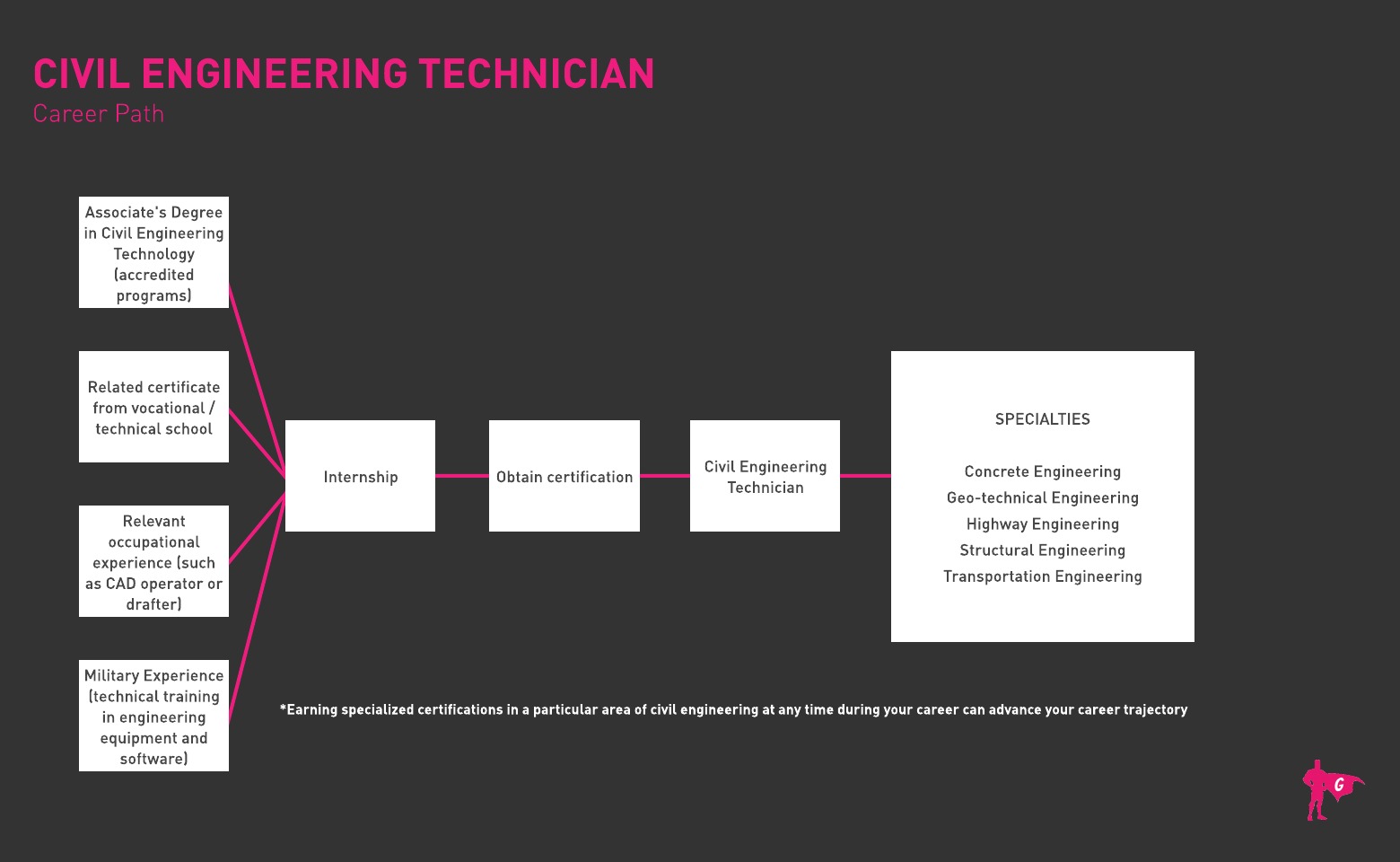
Most Civil Engineering Technicians earn an associate degree in civil engineering technology, surveying technology, or a related field from a community or technical college, typically a two-year program. Coursework blends classroom instruction in math, drafting, and materials science with hands-on lab and field training. Some technicians enter the field with a high school diploma and gain skills through on-the-job training or certificate programs, though an associate degree generally opens more doors and higher starting pay. Certifications in specific areas like concrete or soils testing, often through organizations like the American Concrete Institute, can boost employability significantly.
Students can take courses in relevant subjects such as:
- Civil Engineering Technology Fundamentals
- Surveying and GPS Technology
- CAD and Civil 3D Drafting
- Materials Testing (Soils, Concrete, Asphalt)
- Construction Methods and Materials
- Applied Math and Statistics
- Hydraulics and Hydrology Basics
- Construction Codes and Inspection Standards
- GIS Fundamentals
- Technical Writing and Report Preparation
Hands-on lab and field experience is essential, since much of this job is learned by doing, not just studying. Internships or co-op placements with engineering firms, testing labs, or public works departments give students real exposure to field equipment and workplace expectations. Many technicians pursue certifications throughout their careers, such as ACI concrete testing certification or NICET certification, to formally validate their skills and support advancement.
- Decide if you want to pursue an associate’s or an initial certification to get started
- Stock up on courses in engineering, design, chemistry, physics, geometry, and trigonometry
- Learn how to use computer-aided drafting and related software
- Take on entry-level jobs as a drafter or CAD operator to get real world experience
- Volunteer with local Habitat for Humanity construction projects to learn about materials, methods, and tools. Check out overseas opportunities, if you want added adventure!
- Gain extra practical work experience through Civil Engineering Technician internships
- Read articles and watch tutorials about Civil Engineering Technician duties
- Ask working Civil Engineering Technicians if they’ll let you shadow them or if they can mentor you
- Join professional Civil Engineering organizations to learn, grow, and network
- When ready, get certified by the National Institute for Certification in Engineering Technologies or other applicable entities. Certifications aren’t required for all jobs, but they can bolster your credentials
- Programs accredited by ABET's technology accreditation commission (ETAC)
- Modern labs with materials testing and surveying equipment
- Required internship or co-op placements with local employers
- Instructors with real civil engineering or construction industry experience
- Coursework covering both field surveying and lab materials testing
- Strong CAD and Civil 3D training built into the curriculum
- Transfer agreements that let credits count toward a bachelor's degree later
- Preparation for industry certifications such as ACI or NICET
- Career services that track job placement rates for graduates
- Relationships with regional departments of transportation and engineering firms
- Small lab and field sections for real hands-on equipment time
- Flexible or evening options for students who want to work while studying
- Complete at least one internship or co-op with an engineering firm, DOT, or testing lab
- Apply for entry-level titles like Engineering Technician I, Field Technician, or Inspector Trainee
- Build a portfolio of CAD drawings, survey notes, or lab reports from school projects
- Search job boards focused on government and engineering firm openings
- Attend career fairs hosted by your college and by organizations like ASCE and NICET
- Earn an entry-level certification, such as ACI concrete field testing, to stand out
- Highlight hands-on skills on your resume: equipment operated and tests performed
- Practice explaining a class project clearly in interviews, including what you measured and found
- Consider starting with a state DOT or municipal public works department for stable entry-level roles
- Network with instructors, alumni, and guest speakers from local firms and agencies
- Be open to fieldwork in varied weather and physically active daily work
- Show up with reliability and safety awareness; employers value attitude as much as skill
- Master advanced CAD, GIS, and survey technology beyond entry-level requirements
- Earn additional certifications in specialized testing, inspection, or survey work
- Build a reputation for accurate, well-documented field data that engineers trust
- Take on more complex or higher-profile inspection and testing assignments
- Complete a bachelor's degree in civil engineering if you want to pursue licensure
- Pursue NICET certification levels to formally document your technical expertise
- Move into senior technician, inspection lead, or field supervisor roles
- Mentor new technicians and help train them on field and lab procedures
Websites:
- American Society of Civil Engineers (ASCE) - asce.org
- NICET (National Institute for Certification in Engineering Technologies) - nicet.org
- American Concrete Institute (ACI) - concrete.org
- American Council of Engineering Companies (ACEC) - acec.org
- National Society of Professional Engineers (NSPE) - nspe.org
- ABET - abet.org
- SkillsUSA - skillsusa.org
- American Public Works Association (APWA) - apwa.net
- National Society of Professional Surveyors (NSPS) - nsps.us.com
- Engineering.com - engineering.com
- Federal Highway Administration - fhwa.dot.gov
- Roads & Bridges Magazine - roadsbridges.com
Books:
- Elementary Surveying: An Introduction to Geomatics by Charles D. Ghilani and Paul R. Wolf
- Construction Materials, Methods and Techniques by William P. Spence and Eva Kultermann
- Soils and Foundations by Cheng Liu and Jack B. Evett
- Civil Engineering Formulas by Tyler G. Hicks
- Fundamentals of Geotechnical Engineering by Braja M. Das
If you find that being a Civil Engineering Technician isn't the right fit, your skills in fieldwork, testing, drafting, and problem-solving transfer to many related careers.
- Civil Engineer
- Land Surveyor
- Construction Inspector
- Drafting Technician
- Geotechnical Technician
- Construction Estimator
- GIS Technician
- Transportation Planner
- Environmental Technician
- Construction Project Manager
The work of civil engineering technicians can be seen everywhere – in highways, bridges, skyscrapers, airfields, dams, tunnels, and nearly every other structure essential to modern living. Those who succeed in this profession have a natural inclination to solve problems, enjoy hands on work, and communicate successfully with a wide variety of people. This growing field offers a multitude of different work settings, making it an interesting and rewarding field for those who like new challenges.
Newsfeed

Featured Jobs
Online Courses and Tools
Annual Salary Expectations
New workers start around $82K. Median pay is $99K per year. Highly experienced workers can earn around $118K.
Annual Salary Expectations
New workers start around $77K. Median pay is $83K per year. Highly experienced workers can earn around $111K.
Annual Salary Expectations
New workers start around $69K. Median pay is $81K per year. Highly experienced workers can earn around $88K.