







Spotlights
Structural Engineer, Transportation Engineer, Geotechnical Engineer, Water Resources Engineer, Environmental Engineer, Construction Engineer, Municipal Engineer, Coastal Engineer, Highway Engineer, Site Development Engineer, Bridge Engineer, Consulting Engineer
The bridge you drive across without a second thought, the skyscraper that stands firm in high winds, the dam that holds back millions of gallons of water, and the water system that delivers clean water to your tap all exist because a Civil Engineer designed them to work, and to last. Civil Engineers are the people who take a community's needs, whether it's a safer highway interchange, a new hospital, or flood protection for a coastal town, and turn them into structures and systems that hold up for generations.
Civil Engineers design roads, bridges, buildings, water and sewer systems, dams, and other infrastructure, using math, physics, and engineering principles to make sure every structure can safely handle the loads, weather, and use it will face over decades. They lead project teams that include civil engineering technicians, surveyors, architects, and construction contractors, and they coordinate with government agencies, city planners, and the public throughout a project's life, from initial concept through design, permitting, and construction oversight. Because their designs carry real legal weight, most Civil Engineers must earn a Professional Engineer (PE) license, which makes them personally accountable for the safety and soundness of what they design.
Using structural analysis software, hydraulic modeling tools, CAD and Building Information Modeling (BIM) platforms, and rigorous calculations grounded in physics and materials science, Civil Engineers turn ambitious plans into buildable, safe reality. Their work quite literally shapes the physical world people live in, and a well-engineered structure can protect lives, connect communities, and stand strong for a hundred years or more.
- Designing infrastructure that shapes how entire communities live, travel, and thrive
- Solving complex technical problems where math and physics directly protect public safety
- Seeing a project evolve from early calculations to a finished bridge, building, or system you can visit
- Earning a respected, well-compensated profession with a clear path to licensure and leadership
“As a civil engineer I am in a global network of experts working with clients, communities and colleagues to develop and implement innovative solutions to the world’s most complex challenges. We deliver clean water and energy. Building iconic skyscrapers. Plan new cities. Restore damaged environments. Connect people and economies with roads, bridges, tunnels and transit systems. Design parks where children play. Help governments maintain stability and security” – Moises Young
Working Schedule
Most Civil Engineers work full-time, and many put in additional hours during critical design phases or as project deadlines approach. The work happens primarily in an office setting, where engineers run calculations, build models, and prepare drawings and reports, but it also includes regular site visits to inspect construction progress, meet with clients, or assess existing infrastructure firsthand. Civil Engineers are employed by engineering consulting firms, government transportation and public works agencies, construction companies, and increasingly by ports and coastal agencies working on climate resilience projects. Deadlines tied to public bidding processes, permitting timelines, or funding cycles can create demanding stretches, especially for engineers managing multiple concurrent projects.
Typical Duties
- Designing roads, bridges, buildings, water systems, and other infrastructure projects
- Performing structural, hydraulic, and geotechnical calculations to ensure safety and stability
- Preparing detailed engineering drawings, specifications, and construction documents
- Reviewing site conditions, surveys, and soil reports to inform design decisions
- Ensuring designs comply with building codes, environmental regulations, and safety standards
- Preparing cost estimates and project budgets for proposed infrastructure
- Coordinating with architects, contractors, and other engineering disciplines on complex projects
- Overseeing or reviewing construction to confirm work matches approved engineering designs
- Presenting design plans and project updates to clients, government agencies, and the public
- Applying for and managing permits required for construction projects
- Investigating and resolving structural or infrastructure problems on existing systems
- Signing and stamping final engineering designs as a licensed Professional Engineer
Additional Responsibilities
- Managing engineering teams, including technicians and junior engineers
- Writing technical reports and feasibility studies for proposed projects
- Conducting site assessments after natural disasters to evaluate structural damage
- Staying current on evolving building codes and engineering standards
- Mentoring engineering technicians and entry-level engineers
- Participating in public meetings to explain and defend project designs
- Pursuing continuing education required to maintain a PE license
- Contributing to sustainability and resilience planning for infrastructure projects
A Civil Engineer's day often starts with reviewing project priorities and checking in with team members working on different phases of a design, from a technician finishing survey data to a junior engineer running a drainage calculation. Mornings are frequently spent deep in technical work: running structural or hydraulic models, refining a design based on new site information, or reviewing a technician's field report for anything that might affect the plan.
Midday might include a site visit to an active construction project, walking the site with a contractor to confirm work is proceeding according to the approved design and addressing any field issues that have come up. Back at the office, engineers often meet with clients or government reviewers to discuss project status, present design options, or work through permitting questions and regulatory requirements.
Afternoons frequently involve coordination: reviewing drawings from architects or other engineering disciplines to make sure everything fits together, updating cost estimates as a design evolves, or preparing materials for an upcoming public hearing. Before wrapping up, engineers document design decisions carefully, since these records matter both for the project and for the legal responsibility that comes with a PE stamp.
“I first catch up on emails for the 3 projects I am managing. Then I check in with project task engineers to make sure the project teams are set for the day. I review the engineering assignments and sign off on them. I also run project meetings to update team on project budget and schedule. Lastly I coordinate with the clients regarding the project progression.” – Moises Young
Soft Skills
- Strong analytical and mathematical reasoning
- Clear communication with clients, contractors, and the public
- Leadership and project management ability
- Sound judgment and comfort with legal and professional responsibility
- Attention to detail across complex, multi-year projects
- Collaboration across engineering disciplines and with architects
- Problem-solving under real-world constraints like budget and site conditions
- Ethical decision-making, since designs affect public safety
- Adaptability when regulations, funding, or site conditions change
- Ability to explain technical concepts to non-technical audiences
- Time and project management across multiple assignments
- Resilience when navigating permitting delays or design setbacks
Technical Skills
- Structural analysis and design software such as SAP2000, STAAD.Pro, or ETABS
- Hydraulic and hydrologic modeling for drainage and water systems
- CAD and Building Information Modeling (BIM) platforms such as Civil 3D and Revit
- Deep knowledge of building codes, safety standards, and design specifications
- Geotechnical engineering principles for foundation design
- Materials science and structural mechanics
- Cost estimating and project budgeting
- Understanding of construction methods and sequencing
- Environmental regulations relevant to infrastructure projects
- GIS mapping for site and infrastructure planning
- Structural Engineer: Designs buildings, bridges, and structures to safely bear loads and forces
- Transportation Engineer: Designs roads, highways, and traffic systems
- Geotechnical Engineer: Studies soil and rock to design safe building foundations
- Water Resources Engineer: Designs water supply, drainage, and flood control systems
- Environmental Engineer: Focuses on pollution control, water treatment, and sustainability
- Construction Engineer: Manages the engineering side of active construction projects
- Coastal Engineer: Designs infrastructure to withstand waves, tides, and rising sea levels
- Municipal Engineer: Oversees public infrastructure planning for cities and towns
- Civil and structural engineering consulting firms
- State and federal departments of transportation
- Municipal and county public works departments
- Construction companies and general contractors
- Environmental consulting firms
- Port authorities and coastal management agencies
- Architecture and engineering (A/E) firms
- Federal infrastructure and water resource agencies
- Utility companies
- Airport authorities
- Real estate development companies
- University and government research labs focused on infrastructure resilience
Civil Engineers carry legal and professional responsibility that few other careers do. Once licensed, an engineer's stamp on a design means they are personally accountable for its safety, which requires constant diligence, thorough documentation, and a willingness to slow down and double-check calculations even under deadline pressure. Getting something wrong isn't just a professional embarrassment; it can put public safety at real risk.
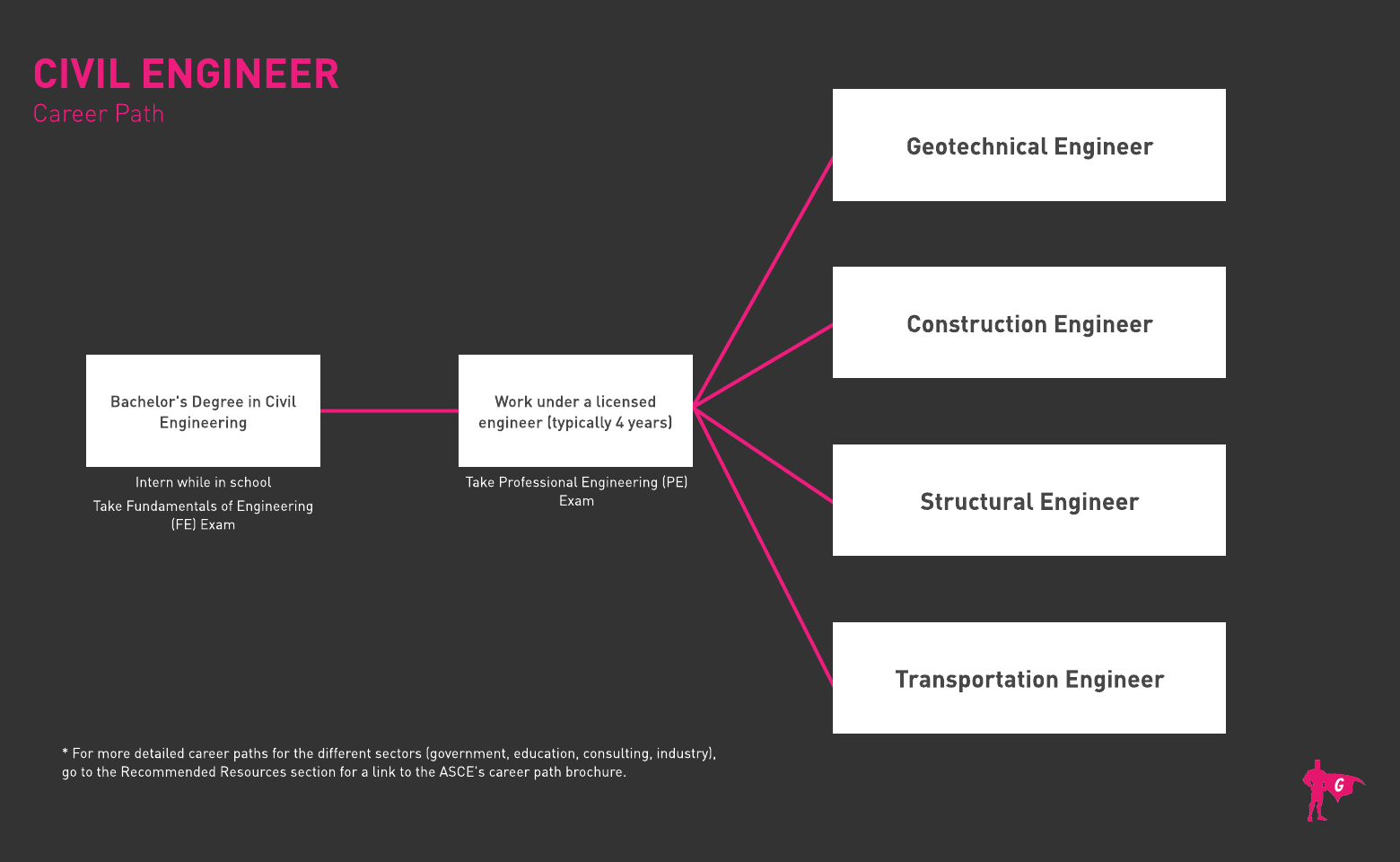
The path to full licensure is long. Civil Engineers typically need a four-year bachelor's degree, several years of supervised experience, and two rigorous licensing exams before becoming a fully licensed Professional Engineer, which usually takes six to eight years from the start of college. This is a significant time investment before reaching full earning and design authority.
The job also involves navigating bureaucracy: permitting processes, public hearings, budget constraints, and regulatory review can slow projects down and require patience and persistence. Site visits mean occasional travel and time outdoors in all kinds of weather, and project deadlines tied to funding cycles or construction schedules can create demanding stretches of long hours.
- Rising investment in infrastructure repair and modernization across the country
- Growing focus on climate resilience, including flood protection and coastal engineering
- Increased use of Building Information Modeling (BIM) for coordinated, data-rich design
- Expansion of sustainable design practices and green infrastructure requirements
- Growth in renewable energy infrastructure projects requiring civil engineering support
- Rising demand for engineers skilled in seismic and extreme-weather-resistant design
- Increased use of AI-assisted modeling and simulation tools in early design phases
- Growth in smart infrastructure projects integrating sensors and real-time monitoring
- Expansion of public-private partnerships funding major infrastructure projects
- Rising need for engineers focused on aging bridge and water system rehabilitation
“Developing/improving smart materials, sustainable designs, energy efficient buildings, new computer software's for virtual/augmented reality design.” – Moises Young
Many Civil Engineers grew up loving building sets, model bridges, and construction toys, often testing how much weight a structure could hold before it collapsed. They tended to excel in math and physics, especially when the material connected to something tangible, like calculating how a bridge or building actually stands up.
Others found their spark in robotics competitions, science fairs focused on structures or bridges, or curiosity sparked by watching construction projects and infrastructure around their community. A combination of strong analytical thinking, interest in how the built world works, and a drive to solve real, high-stakes problems often pointed these future engineers toward the profession.
Becoming a Civil Engineer requires a bachelor's degree in civil engineering from an ABET-accredited program, typically a four-year course of study covering structural analysis, hydraulics, geotechnical engineering, and design. After graduating, most civil engineers take the Fundamentals of Engineering (FE) exam to become an Engineer in Training (EIT), then work under a licensed Professional Engineer for several years before taking the Principles and Practice of Engineering (PE) exam to become fully licensed. Many engineers pursue a master's degree, especially those specializing in structural, geotechnical, or environmental engineering, to deepen their expertise and open doors to more advanced design work.
Students can take courses in relevant subjects such as:
- Statics and Dynamics
- Structural Analysis and Design
- Geotechnical Engineering
- Hydraulics and Hydrology
- Transportation Engineering
- Construction Materials and Methods
- Calculus and Differential Equations
- Fluid Mechanics
- Environmental Engineering Principles
- Engineering Ethics and Professional Practice
Hands-on experience through internships and co-op programs with engineering firms or government agencies is critical, both for building real design skills and for accumulating the supervised experience required for PE licensure. Building relationships with mentors during this period often shapes a young engineer's specialty and career trajectory. Continued education is required throughout a civil engineer's career to maintain licensure and stay current with evolving codes and technology.
- Take calculus, physics, and chemistry, and pursue the most advanced math available
- Join a robotics team, bridge-building competition, or engineering club
- Participate in Science Olympiad events focused on structural design
- Learn a basic CAD program like AutoCAD or Fusion 360 on your own
- Research ABET-accredited civil engineering programs and their admission requirements
- Attend a summer engineering program at a university if available
- Job shadow or interview a practicing civil engineer about their day-to-day work
- Apply for internships with engineering firms, DOTs, or construction companies
- Build strong writing and public speaking skills for presenting designs and reports
- Get comfortable with spreadsheets, basic programming, and data analysis
- Pursue leadership roles in school clubs to build project management experience
- Learn about the FE and PE licensing exams early so you understand the full path
- ABET accreditation, which is required for PE licensure in most states
- Strong hands-on lab work in structures, materials, and geotechnical testing
- Required or strongly encouraged internship and co-op placements
- Faculty with real engineering practice experience, not just research backgrounds
- A senior capstone project where you design a real infrastructure solution
- Coursework in current design software like Civil 3D, Revit, or structural analysis tools
- High pass rates on the FE exam among graduating seniors
- Opportunities to specialize in structural, transportation, geotechnical, or water resources tracks
- Strong career services and relationships with regional engineering firms and agencies
- Research opportunities in resilience, sustainability, or infrastructure innovation
- Study abroad or exchange programs exposing students to different infrastructure systems
- Reasonable class sizes that allow direct access to professors and mentorship
- Complete at least one internship or co-op with an engineering firm or government agency before graduating
- Take and pass the FE exam during your senior year to become an Engineer in Training
- Build a portfolio of design projects, including your senior capstone project
- Apply for entry-level titles like Staff Engineer, Design Engineer, or Engineer in Training
- Search job boards, company career pages, and organizations like ASCE for openings
- Attend career fairs hosted by your engineering school and professional societies
- Highlight relevant coursework, software skills, and internship projects on your resume
- Practice explaining a design project clearly in interviews, including tradeoffs you weighed
- Network with professors, alumni, and internship supervisors who often know about openings first
- Consider starting at a government agency for stable entry-level experience and mentorship
- Be open to relocating to regions with strong infrastructure investment and engineering demand
- Show genuine enthusiasm for public safety and long-term project impact in interviews
“Work on a solid resume, interview with as many companies as you can, be prepared for your interview, dress appropriately, have a firm handshake, do your research on the company.” - Moises Young
- Accumulate the supervised experience required to sit for the PE licensing exam
- Pass the PE exam to become a fully licensed Professional Engineer with design authority
- Specialize in a high-demand area like structural, geotechnical, or coastal resilience engineering
- Take on project management responsibilities and lead increasingly complex designs
- Build a reputation for sound, well-documented engineering judgment
- Pursue a master's degree or additional certifications to deepen technical expertise
- Move into senior engineer, project manager, or engineering director roles
- Mentor junior engineers and engineering technicians to build leadership skills
Websites:
- American Society of Civil Engineers (ASCE) - asce.org
- National Society of Professional Engineers (NSPE) - nspe.org
- National Council of Examiners for Engineering and Surveying (NCEES) - ncees.org
- American Council of Engineering Companies (ACEC) - acec.org
- ABET - abet.org
- Structural Engineering Institute (SEI) - asce.org/sei
- American Public Works Association (APWA) - apwa.net
- Federal Highway Administration - fhwa.dot.gov
- Engineering.com - engineering.com
- Civil Engineering Magazine - asce.org/publications
- American Concrete Institute (ACI) - concrete.org
- Society of Women Engineers (SWE) - swe.org
Books:
- Civil Engineering Formulas by Tyler G. Hicks
- Structural Analysis by Russell C. Hibbeler
- Fundamentals of Geotechnical Engineering by Braja M. Das
- Engineering Ethics: Concepts and Cases by Charles E. Harris, Michael S. Pritchard, and Michael J. Rabins
- Design of Reinforced Concrete by Jack C. McCormac and Russell H. Brown
If you find that being a Civil Engineer isn't the right fit, your skills in analysis, design, and project leadership transfer to many related careers.
- Civil Engineering Technician
- Structural Engineer
- Architect
- Construction Project Manager
- Environmental Engineer
- Urban and Regional Planner
- Transportation Planner
- Geotechnical Engineer
- Construction Manager
- Land Surveyor
“Stay focused and greatness will come. Think about who you are, what you want to do with your life, and how you can give back to the community.” – Moises Young
Newsfeed

Featured Jobs
Online Courses and Tools
Annual Salary Expectations
New workers start around $86K. Median pay is $104K per year. Highly experienced workers can earn around $132K.
Annual Salary Expectations
New workers start around $99K. Median pay is $121K per year. Highly experienced workers can earn around $149K.
Annual Salary Expectations
New workers start around $98K. Median pay is $129K per year. Highly experienced workers can earn around $153K.